Under Pressure: Why Miami's Fine Dining Kitchens Are Finally Listening to Grandma
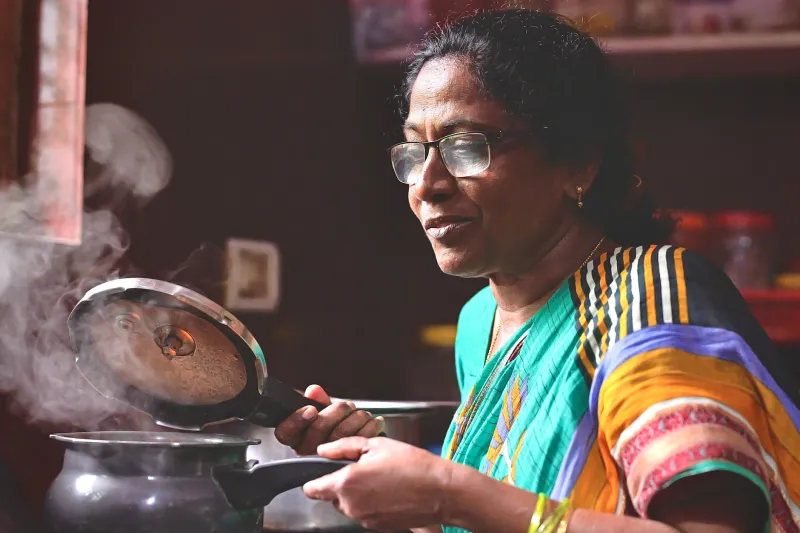
There's a sound every Cuban kid who grew up in Miami knows — that steady, rhythmic hiss from the back of the kitchen, the pressure cooker doing its thing while abuela moved around it like it was just another Tuesday. No fuss. No thermometers. No timers set with military precision. Just a pot, some steam, and an understanding that had been passed down through kitchens in Havana, Caracas, Beirut, and Naples long before anyone thought to write it down.
For decades, fine dining treated that sound like something to move past. Serious cooking meant low-and-slow braises, multi-hour stocks, and the kind of patience that only a fully staffed brigade could afford. The pressure cooker was a home appliance — efficient, sure, but not exactly glamorous.
That thinking is shifting fast.
Across Miami right now, a growing number of chefs at serious restaurants are pulling pressure cookers — and their more sophisticated commercial cousins — back into the conversation. Not as a shortcut, but as a technique with genuine depth. The immigrant home kitchens of Miami, it turns out, were never behind the times. They were just ahead of them.
What the Science Actually Says
The case for pressure cooking isn't just nostalgic. It's chemical.
When you cook under pressure, the boiling point of water rises — from 212°F at sea level to around 250°F inside a sealed pot. That extra heat accelerates the breakdown of collagen into gelatin, softens tough plant fibers faster, and drives flavor compounds into the liquid in a fraction of the time a conventional braise would take. A pot of beans that might take two hours on the stovetop is done in twenty minutes. A pork shoulder that needs four hours in the oven can reach the same fork-tender result in under an hour.
But here's the part that surprises people: speed doesn't mean shallow. Because the cooking environment is sealed, volatile aromatics — those fragrant compounds that usually escape into your kitchen as steam — stay trapped in the pot. The result is often a more concentrated, more layered flavor than you'd get from an open braise. You're not losing anything. You're keeping it all.
This is exactly what home cooks in Latin America and the Mediterranean have understood for generations, even if they didn't have the vocabulary to explain it that way. They just knew the food tasted right.
From the Home Kitchen to the Line
Chef Marisol Fuentes runs a small but well-regarded modern Venezuelan restaurant in Wynwood. She grew up watching her mother cook caraotas negras — Venezuela's beloved black beans — in a pressure cooker every single week. When she opened her own place, she initially defaulted to the conventional methods she'd learned in culinary school. The beans were fine. They just weren't her mother's beans.
"It took me two years to admit that the pressure cooker was the answer," she says, laughing. "In school, you're taught that real technique means time. But my mom's beans had more depth than anything I was making the 'right' way. I had to get over myself."
Fuentes now uses a commercial pressure cooker for her bean preparations, her short rib ragu, and a slow-cooked chicken broth that forms the base of her signature soup. She's not alone in making this pivot.
Across town, a Greek-American chef working out of a Brickell tasting menu spot has incorporated pressure-cooked lamb neck into his menu — a technique he traces directly to his grandmother's kitchen in Thessaloniki. The neck, notoriously fibrous and time-consuming, comes out silky and deeply savory in about 45 minutes under pressure. He serves it alongside a yogurt made in-house and a salsa verde that nods to both Greek and Colombian flavor profiles — a combination that feels completely at home in Miami.
"The pressure cooker gives me the texture I want without cooking all the personality out of the meat," he explains. "It's not lazy cooking. It's smart cooking."
The Restaurant Economics Nobody Talks About
There's a practical dimension here that chefs are willing to discuss more openly than you might expect. Running a restaurant in Miami is expensive. Labor costs are real. Energy costs are real. A technique that delivers better results in less time isn't just philosophically appealing — it makes the whole operation more viable.
A braise that requires four hours of oven time at 325°F costs significantly more in gas or electricity than a pressure-cooked version that's done in under an hour. Multiply that across a week of service and the numbers add up in a hurry. For smaller, independent restaurants — the kind that define Miami's most interesting dining scene — that efficiency isn't a compromise. It's a lifeline.
But the chefs who've made the switch are careful to separate efficiency from laziness. The pressure cooker isn't doing all the work. Seasoning still matters. Building the initial flavor base — your sofrito, your mirepoix, your toasted spices — still requires attention and skill. What the pressure cooker does is take that foundation and drive it deeper, faster, without the babysitting.
Rewriting the Hierarchy of Technique
What's interesting about this moment in Miami's food culture is what it says about who gets to define good cooking. For a long time, the techniques that got celebrated in fine dining were largely European in origin — French mother sauces, Italian slow braises, Spanish emulsions. Immigrant home cooking, by contrast, was treated as folk knowledge. Charming, maybe. Authentic, sure. But not quite serious.
The pressure cooker's rehabilitation is part of a broader reckoning with that hierarchy. When a chef at a tasting menu restaurant in Brickell is using the same technique as a Cuban grandmother in Hialeah — and getting better results because of it — the line between folk wisdom and culinary sophistication starts to look pretty arbitrary.
Miami has always been a city where those lines blur. It's part of what makes eating here so interesting. The best meals in this city have never cared much about pedigree. They've cared about flavor.
The Vessel as a Value Statement
There's something almost poetic about watching a cooking tool that immigrant families brought with them from Cuba, Venezuela, Lebanon, and Greece end up on the prep list at Miami's most ambitious restaurants. The pressure cooker crossed the same oceans these communities did. It survived the same transitions, the same reinventions, the same process of adapting old knowledge to a new place.
Now it's sitting on the line next to the immersion circulators and the Japanese mandolines, and nobody thinks twice about it.
Maybe that's exactly where it always belonged.