Pinch by Pinch: The Florida Salt Harvesters Quietly Changing How Miami Cooks
Salt is the one ingredient every cook reaches for without thinking. It's the thing you run out of and replace with whatever's cheapest at the grocery store. It's background noise. Infrastructure. And yet, somewhere along Florida's coastline, a handful of people are treating it like something sacred — and the ripple effects are showing up on plates at some of Miami's most interesting restaurants.
Artisanal sea salt is not a new concept. The French have their fleur de sel. The Portuguese have their Salinas. But Florida? Florida has warm, mineral-rich coastal waters, a climate that actually makes small-batch solar evaporation viable for much of the year, and a food scene hungry enough to use something this local and this specific. What it hasn't had — until recently — is the infrastructure, the patience, and the people willing to do the slow, unglamorous work of harvesting salt by hand.
That's starting to change.
What Makes Florida Salt Different
Sea salt is, at its most basic, what's left after seawater evaporates. Industrial producers speed that process up dramatically, using heat, vacuum chambers, and chemical refinement to strip out everything except sodium chloride. The result is consistent, cheap, and essentially flavor-neutral — which is exactly what most large-scale food manufacturing needs.
Hand-harvested salt works on a different timeline and preserves a different profile. When seawater evaporates slowly under the sun, it leaves behind not just sodium chloride but a complex mix of trace minerals — magnesium, calcium, potassium, and sulfates among them. These aren't present in large amounts, but they matter. They change texture. They change the way salt dissolves on the tongue. They change the way it interacts with fat, acid, and heat.
Florida's coastal waters carry their own mineral signature, shaped by the Gulf Stream, the shallow warm flats of the Keys and the Gulf side, and the particular chemistry of subtropical runoff. Salt pulled from these waters tastes different from salt pulled from the coast of Maine or the shores of Brittany. Not dramatically different — we're talking about nuance here — but different enough that chefs who've worked with it notice immediately.
"The first time I used a local Florida flake on a crudo, I stopped and just stood there for a second," says one Miami chef who sources exclusively from a small operation outside of Homestead. "It has this brightness that cuts through the fish oil in a way that table salt just doesn't. It's not sharper, exactly. It's cleaner."
The People Doing the Work
The salt harvesting community in Florida is genuinely small — we're talking about a handful of serious producers and a few more hobbyists who haven't quite decided if they're building a business or just pursuing an obsession. What they share is a willingness to work with the water rather than against it.
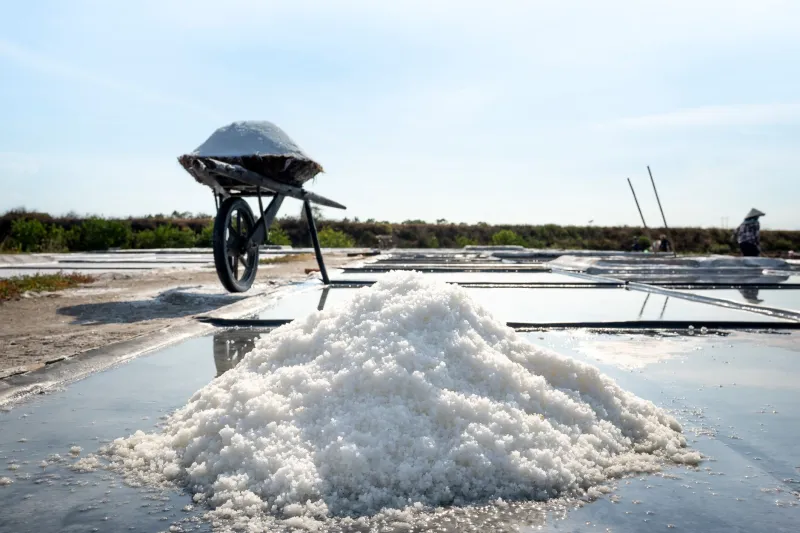
The basic process involves drawing seawater into shallow evaporation pans, then waiting. Florida's heat does a lot of the work, but the waiting is not passive. Harvesters monitor salinity levels, manage algae growth, adjust flow between pans, and time their harvests carefully — pulling salt at different stages of crystallization produces different textures and mineral concentrations. Early harvest yields finer, wetter crystals. Letting the process run longer produces the large, dramatic flakes that chefs love to finish a dish with.
One producer working out of a small plot near the Everglades watershed describes the process as reading the water. "Every batch is different. The temperature, the wind, what's happening in the water that week — it all shows up in the salt. Some batches are almost sweet. Some have more of that briny depth. You can't fully control it, and honestly, that's the point."
That unpredictability is a feature for chefs who value seasonality and terroir. It's a challenge for anyone trying to build a consistent supply chain. Most of these producers are selling directly to restaurants, at farmers markets, or through small regional distributors — not to big-box retailers. Volume is limited. Prices reflect the labor involved. And that's fine, because the restaurants buying this salt aren't using it the way they'd use Morton's.
How Miami's Chefs Are Actually Using It
Hyperlocal salt has found its way into Miami kitchens in a few distinct roles, and the most interesting uses are the ones that treat salt as a flavor ingredient rather than just a seasoning tool.
Finishing salt is the obvious application — a pinch of large-flake Florida sea salt on a seared piece of fish, a lamb chop, a slice of avocado toast. The visual appeal is real, but the functional appeal is more important. Finishing salt doesn't dissolve into the food the way cooking salt does. It sits on the surface, delivers a burst of flavor when you bite through it, and adds textural contrast. The mineral complexity in hand-harvested salt makes that burst more interesting.
But some chefs are going further. At least two Miami restaurants are currently using local salt in their cocktail programs — rimming glasses with Florida flakes instead of standard kosher salt, and incorporating salt-forward shrubs and brines that highlight the mineral character of locally harvested product. The effect on a mezcal margarita or a Mediterranean-influenced spritz is subtle but real.
Salt-curing is another area where local product shines. One restaurant known for its Latin-Mediterranean hybrid menu has been experimenting with a Florida sea salt cure for their in-house charcuterie, arguing that the mineral profile of local salt interacts differently with pork fat than industrial salt does. Whether that's provably true or partly a story they're telling themselves doesn't entirely matter — the cured meats are excellent, and the sourcing narrative adds something to the dining experience.
There's also a growing interest in flavored and infused salts using local ingredients. Citrus-smoked Florida sea salt. Salt blended with dried ají amarillo. Salt cured with culantro from a farm an hour north of the city. These products sit at the intersection of the salt movement and Miami's broader obsession with hyperlocal, cross-cultural flavor building.
Why This Matters Beyond the Plate
It would be easy to dismiss artisanal sea salt as a luxury indulgence — something for tasting menus and Instagram-friendly finishing moments. And sure, at $18 for four ounces, it's not replacing anyone's iodized table salt. But the conversation around local salt is really a conversation about what it means to cook with a sense of place.
Miami's food identity has always been shaped by migration, by the collision of cultures, by the energy of people bringing their traditions to a new geography. What artisanal sea salt adds is something rooted in the specific physical environment of South Florida — the water, the sun, the particular chemistry of this coastline. For a city still working out what its culinary identity actually is, that kind of ingredient carries real meaning.
The salt whisperers working Florida's coastal edges aren't trying to compete with global producers. They're doing something smaller and, in its way, more interesting — they're capturing a taste of this specific place, at this specific moment, and handing it to the chefs and cooks who know what to do with it.
One pinch at a time.