Ember and Instinct: How Miami's Best Chefs Are Cooking with Fire Again
There's a moment, somewhere between the first crack of wood splitting and the smell of smoke settling into a dining room, when you understand why humans have been cooking over fire for a very long time. It just works. And in Miami right now, a growing number of chefs are betting their entire menus on that primal fact.
This isn't about novelty. It's not about a wood-fired pizza oven tucked in the corner as a decorative afterthought. What's happening across Miami's Latin and Mediterranean restaurant kitchens is something more deliberate — a full recommitment to open flame, live coals, and the kind of patience that a gas burner simply cannot replicate.
Why Fire, Why Now
Ask any of these chefs why they went back to fire and you'll get roughly the same answer dressed in different words: because nothing else does what fire does.
Heat from a gas range is clean and controllable, which sounds like a compliment but isn't always. It produces no char, no smoke, no unpredictability. The food that comes off it can be technically perfect and somehow still flat. Fire, on the other hand, is a collaborator. It pushes back. It demands attention and rewards it with flavors — bitter, smoky, caramelized, crackling — that exist nowhere else on the flavor spectrum.
For Miami's Latin and Mediterranean chefs specifically, the return to fire carries extra weight. These are culinary traditions built around it. Argentine asado is not a grilling technique; it's a philosophy. Spanish espetos — whole sardines skewered on cane and cooked over driftwood embers on the beach — are practically a religion along the Costa del Sol. Cuban lechon, slow-roasted over a wood fire in a caja china or directly over an open pit, is the centerpiece of every serious celebration. These chefs aren't discovering fire. They're returning to it.
The Asado Influence
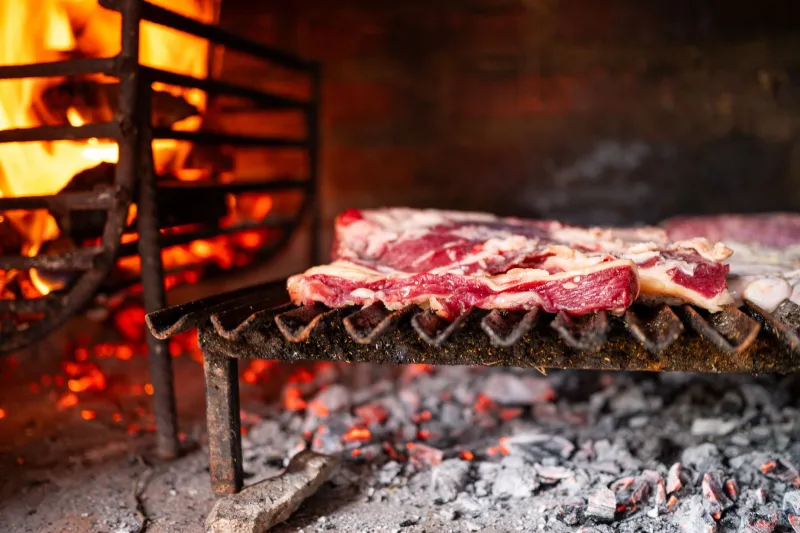
Of all the live fire traditions making noise in Miami kitchens right now, Argentine asado has arguably the deepest footprint. The technique — which prioritizes low, indirect heat from hardwood coals rather than the high direct flame most American grillmasters reach for — produces meat with a texture and depth that's genuinely different from anything coming off a conventional grill.
The key is the quebracho or algarrobo wood, dense South American hardwoods that burn long and hot with minimal flare-up. Chefs who've committed to the method talk about learning to read the fire the way a baker reads dough — watching the color of the coals, feeling the radiant heat with a hand held at grill height, adjusting the distance between the grate and the embers in small increments over hours.
What comes out the other side is beef that's deeply bronzed on the exterior but impossibly juicy inside, carrying a smoke signature that's present without being aggressive. Miami's Argentine-influenced kitchens have been quietly refining this for years, and now the wider dining public is starting to notice.
Sardines, Smoke, and the Spanish Connection
On the Mediterranean side of Miami's fire cooking story, the espeto tradition is finding a small but passionate audience. Originally from Málaga, espetos involve threading fresh sardines onto thin bamboo or cane skewers and cooking them over wood embers in a shallow boat filled with sand — the sand acting as ballast and heat insulator simultaneously.
Transplanting that to a Miami kitchen requires adaptation. The beach-side setup isn't always practical, but the core principle — whole fish, live fire, minimal intervention — translates beautifully. Chefs working in this tradition tend to extend the approach beyond sardines to local Gulf and Atlantic species: mackerel, pompano, whole snapper. The fire does what a pan never could, crisping the skin while the interior steams gently in its own moisture.
The technique demands fresh fish above almost anything else. When you're cooking this simply, there's nowhere to hide. That pressure, several Miami chefs note, has actually made them better buyers — more attentive to what came in that morning, more willing to change the menu based on what's actually good rather than what was planned.
Lechon and the Long Game
If asado is about patience measured in hours, Cuban lechon is about patience measured in days. The process of preparing a whole roasted pig — marinating it deep in mojo (sour orange, garlic, oregano, cumin), then slow-cooking it over wood or charcoal for the better part of a day — is one of the most labor-intensive traditions in any kitchen. It's also one of the most rewarding.
The exterior skin, when done correctly, achieves a crackling so shatteringly crisp it almost sounds like breaking glass. The interior meat pulls apart in long, tender strands. The fat has rendered completely, basting everything from the inside out. There's a reason this is the dish that appears at quinceañeras, at New Year's parties, at every gathering that matters.
What's changed in Miami's more ambitious restaurant settings is the way lechon is being framed. It's moved off the paper plate and onto proper dinnerware. It's being paired with thoughtful wine lists. The accompaniments — traditionally black beans and rice, yuca with mojo — are being refined without being stripped of their identity. The fire at the center of it all remains unchanged.
Reading the Coals
Across all of these traditions, the chefs who do this well share one quality: they've learned to stop relying on thermometers and timers as primary tools. Live fire cooking is fundamentally about sensory feedback — the sound of fat hitting coals, the color shift in protein as heat penetrates, the smell of smoke changing character as wood moves from flame to ember.
This is a skill that takes time to develop, and several Miami chefs describe early disasters — fires that ran too hot, fish that fell apart, roasts that dried out — as essential parts of their education. The mistakes, they say, teach things that no recipe can.
There's also a communal dimension to fire cooking that sets it apart from most other techniques. In Argentine asado culture, the asador — the person tending the fire — holds a position of real social significance. In Mediterranean traditions, cooking over fire is rarely a solitary act. It draws people in, creates conversation, demands an audience.
Miami, a city built on exactly that kind of social energy, turns out to be a very natural home for it.
The Flavor Nobody Planned For
One thing every live fire cook eventually discovers is the happy accident. The moment when the fire does something unexpected — a flare-up that chars an edge in a way that turns out to be perfect, an ember that rolls under a piece of meat and creates a crust on a surface you didn't anticipate — and the result is better than anything you planned.
That's the thing about cooking with fire that no amount of kitchen technology has been able to replicate. It's alive in a way that a controlled heat source simply isn't. And in a city where the best food has always carried a little chaos in its DNA, Miami's live fire chefs feel less like they're going backward and more like they've finally found the right direction.