No Diploma, No Problem: Why Miami's Most Valuable Culinary Education Is Happening in Living Rooms
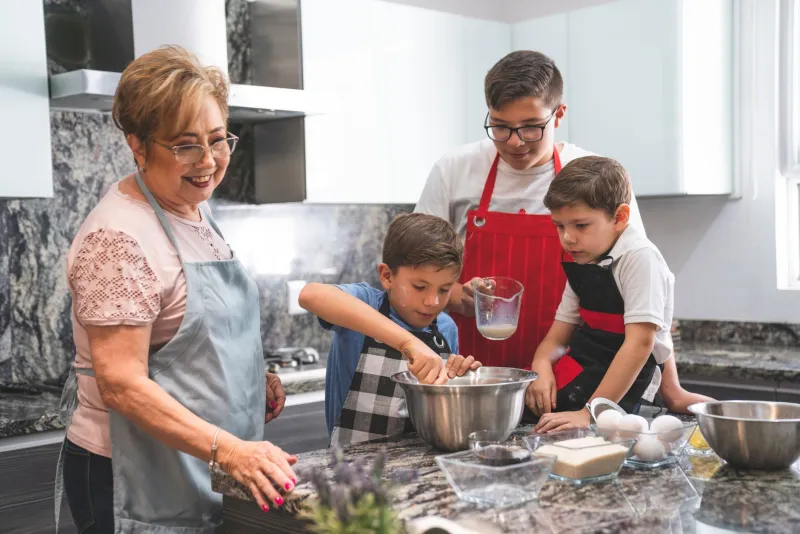
There's a kitchen in Little Havana where the windows fog up every Saturday morning. Rosario Méndez, 74, doesn't advertise. She doesn't have a website or an Instagram handle or a waitlist. What she has is a cast-iron pot that belonged to her mother, a shelf crowded with unlabeled jars, and a circle of five or six people — some of them her grandchildren, some of them line cooks from restaurants you'd recognize — who show up ready to learn.
"I don't teach recipes," she says, adjusting the heat on a sofrito that's been simmering for the better part of an hour. "I teach you how to listen to the food."
This is the culinary education Miami doesn't talk about enough. While the city celebrates its James Beard nominees and its celebrity chef outposts and its parade of tasting menus, a quieter revolution is happening at the residential level — in Hialeah apartments, Kendall kitchens, and Wynwood walk-ups where immigrant home cooks are passing down techniques, instincts, and flavor memories that no formal institution has ever bothered to document.
What the Culinary Schools Missed
Professional kitchens have always had a complicated relationship with tradition. Culinary schools teach precision — knife angles, classical French mother sauces, the Maillard reaction explained on a whiteboard. What they don't always teach is feel. The way a properly seasoned pot of black beans smells different at each stage. How the sound of frying changes when the oil is ready. The specific resistance of masa that tells you it needs more lard.
Those lessons live in people, not textbooks.
Chef Daniel Arango, who runs a well-regarded Colombian-Mediterranean small plates spot in Brickell, spent two years at a culinary institute in New York before moving to Miami. He'll tell you the most important cooking education he ever received came later, sitting in his aunt's kitchen in Medellín on a visit home, watching her make hogao — the slow-cooked tomato and scallion sauce that anchors half of Colombian home cooking.
"She wasn't teaching me the recipe," he says. "She was teaching me patience. She was teaching me that flavor needs time to become itself. I never learned that anywhere else."
Now, when he develops new dishes, he calls her. He describes what he's trying to build, and she talks him through it. It's informal, it's long-distance, and it's shaped his menu more than any cookbook on his shelf.
The Women Holding the Knowledge
In Miami's Latin and Mediterranean communities, culinary knowledge has historically moved through women — specifically, through mothers and grandmothers who cooked every day of their lives and accumulated a kind of embodied expertise that's genuinely hard to replicate through any other means.
Eleni Papadakis came to Miami from Thessaloniki in the early 1990s. She's been cooking Greek food in her Pinecrest home for over three decades, and for the past several years, she's been hosting informal cooking sessions for a rotating group of neighbors, friends, and the occasional restaurant cook who found her through word of mouth.
Her focus is on the fundamentals of Greek pantry cooking — building ladolemono, working with dried legumes, understanding how olive oil behaves differently depending on what you're asking it to do. She's particular about olive oil. She keeps four different varieties and will spend twenty minutes explaining why each one belongs in a different application.
"In Greece, my grandmother knew the olive trees by name," she says. "Here I can't have that, but I can still teach people to taste the difference. That matters."
Several of the chefs she's worked with informally have started sourcing better Greek olive oils for their restaurants. One has redesigned her whole salad program based on conversations with Eleni about acid balance and fat.
Teaching Without a Curriculum
What makes these kitchen sessions different from a cooking class at a culinary school or even a high-end recreational cooking studio is the absence of structure. There's no syllabus. There's no sequence. You learn what the cook decides to make that day, and the lesson reveals itself in the process.
This is, in many ways, how cooking knowledge has always been transmitted across most of human history. It's apprenticeship in its oldest form — observational, relational, and deeply contextual.
Margarita Fuentes, a Peruvian home cook in Doral who has become something of a quiet legend among the city's ceviche-obsessed chef community, describes her approach as teaching people to trust themselves.
"When you go to school, you learn to follow rules," she says. "When you come to my kitchen, you learn to make decisions. Those are different things."
Her sessions — which she runs for small groups, usually family or friends of family — center on Peruvian technique: the proper balance of ají amarillo heat, the role of leche de tigre as both ingredient and medicine, the way tiradito differs from ceviche not just in form but in philosophy. She's particular about the order of operations. She's even more particular about the quality of the fish.
At least two Miami chefs credit her with fundamentally changing how they approach raw fish preparation. Neither of them paid her a dime.
When Tradition Meets the Restaurant Kitchen
The influence of these home-based educators is showing up on menus across the city in ways that are sometimes visible and sometimes invisible. A chef who spent a Sunday afternoon in someone's abuela's kitchen might not put that on the menu description, but you can taste it — in the depth of a braise, in the restraint of a seasoning hand, in the decision to let something simple stay simple.
What's interesting is the direction of the exchange. It's not just chefs going to home cooks to extract knowledge. Increasingly, home cooks are finding their way into professional conversations — invited to pop-ups, consulted on menu development, sometimes brought into restaurants to cook a single dish for a single night.
Rosario, in her Little Havana kitchen, has been approached twice about formalizing her sessions. Both times she declined. She's not interested in becoming a brand. She's interested in making sure the people who sit at her table leave knowing something real.
"My mother taught me," she says. "Her mother taught her. The chain doesn't break because you put it on the internet."
The Informal Archive
There's a loss built into this kind of knowledge transmission. When it works, it's beautiful — living technique passed hand to hand, generation to generation. When it doesn't, entire culinary vocabularies disappear. Dishes that sustained families for centuries vanish because no one was in the kitchen paying attention at the right moment.
Miami, with its extraordinary density of immigrant communities, is both a place where that loss is acutely felt and a place where the recovery effort is genuinely alive. The home cooks teaching in their living rooms aren't just educators. They're archivists. They're holding something the city needs.
The restaurants get the credit. The grandmothers do the work. Maybe it's time Miami started paying closer attention to whose kitchen the real education is actually happening in.