Low Heat, Long Memory: How Miami's Immigrant Kitchens Are Keeping the Braise Alive
There's a particular kind of smell that means something in Miami. It drifts through apartment hallways and screen doors on Sunday afternoons — onions softening in oil, wine hitting a hot pan, meat beginning its long surrender to heat. It doesn't announce itself loudly. It just settles in, the way a memory does.
For Miami's immigrant communities, the slow braise is far more than a cooking method. It's a clock. A calendar. A language. Across Latin American and Mediterranean households scattered from Hialeah to Kendall to Little Havana, families are keeping alive braising traditions that stretch back centuries — and doing it with the same quiet stubbornness their grandparents brought to this city in the first place.
A Technique Built for Scarcity
Braising was never invented for luxury. Across cultures — whether you're talking about the estofados of colonial Cuba, the stifado of rural Greece, or the lamb-and-chickpea braises of North Africa — the technique evolved as a way to coax flavor and tenderness from cuts of meat that nobody else wanted. Tougher, cheaper, more connective: shanks, shoulders, cheeks, short ribs. The ones that give up their best selves only under sustained, gentle pressure.
Elena Vargas, who emigrated from Havana to Miami's Flagami neighborhood in the early 1990s, learned to braise from her mother using whatever was available. "In Cuba, you didn't choose your cut," she says, laughing. "You chose what was there. And you made it taste like a celebration anyway." Her ropa vieja — shredded flank steak braised low and slow with tomatoes, peppers, and a splash of dry white wine — takes the better part of a Sunday to make. She wouldn't have it any other way.
That philosophy, born from necessity and refined by generations of repetition, is exactly what makes the braise so resonant. It asks nothing from you except time. And in return, it gives you something no shortcut can replicate.
The Greek Side of the Pot
Miami's Greek community — concentrated largely in Tarpon Springs and spread through South Florida's suburbs — has its own braising gospel. Stifado, a deeply aromatic beef or rabbit braise built on whole pearl onions, red wine, cinnamon, and cloves, is one of those dishes that sounds simple until you taste it and realize something profound has happened in that pot.
Nikos Papadimitriou, whose family runs a small Greek market in the Brickell area, grew up watching his yiayia prepare stifado every winter. "She never measured anything," he says. "She'd smell the pot and know. Add a little more vinegar, a little more wine. It was all instinct built over decades." The dish is now something he makes for his own kids, born in Miami, growing up American in every outward sense — but learning, around that stove, what it means to be Greek.
The cinnamon and allspice in stifado are the same spices that traveled Mediterranean trade routes centuries ago. They're also, notably, the same spices that appear in some Cuban and Puerto Rican braises — a reminder that these traditions didn't develop in isolation. They crossed oceans, traded ingredients, and quietly influenced each other in ways that Miami, of all cities, is uniquely positioned to appreciate.
Resistance Disguised as Dinner
Call it what you want — comfort food, heritage cooking, slow food — but there's something deliberately countercultural about spending four hours on a braise in 2025. We live in a city where meal kits, delivery apps, and thirty-minute recipes dominate the conversation. The slow braise refuses all of that. It demands you be home. It demands you check in, adjust, smell, taste. It is, in the most literal sense, a practice.
For many of Miami's immigrant families, that practice carries a weight that goes beyond the kitchen. "When I make my grandmother's lamb with white beans," says Fatima Benali, who came to Miami from Morocco via Spain, "I'm not just cooking. I'm making sure that recipe doesn't die with her." Her braise — lamb shoulder with preserved lemon, cumin, and dried apricots — takes nearly five hours. She makes it on the first Sunday of every month, no exceptions.
This is what food scholars sometimes call culinary resistance: the deliberate act of maintaining food traditions in the face of assimilation pressure. In a city like Miami, where the pressure to blend in is constant and the pace of change is relentless, the slow braise is a quiet act of defiance. You can't rush it. You can't outsource it. You have to make it yourself, the way it was made before you.
From Home Kitchen to Restaurant Menu
Miami's restaurant scene has always had one ear pressed to the city's home kitchens, and lately, that ear has been picking up the low, steady hum of the braise. A growing number of chefs — particularly those with personal ties to Latin American or Mediterranean cooking — are incorporating long-cooked, braised dishes into menus that once leaned heavily on grills and raw preparations.
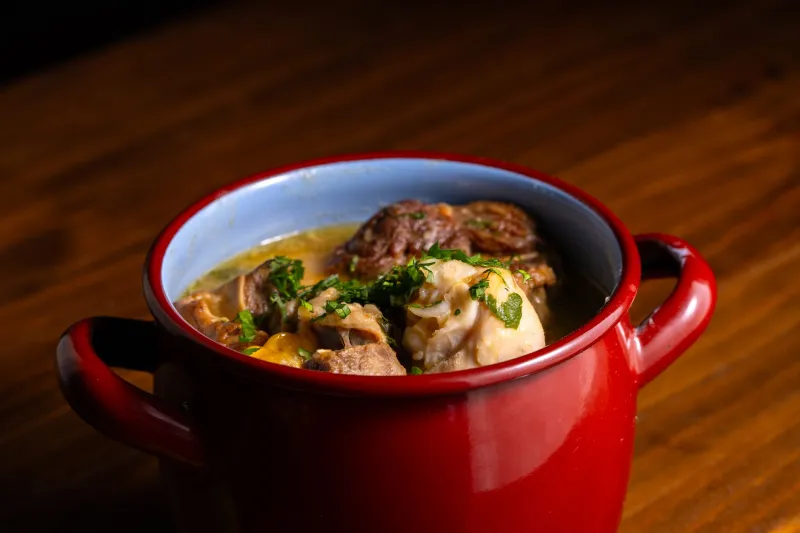
Chef Marco Delgado, who runs a contemporary Cuban-influenced spot in Wynwood, spent six months eating his way through the home kitchens of his staff before redesigning his menu. "Every single person I talked to had a braise," he says. "A different one, from a different country, with a different story. But the technique was always the same: low heat, patience, and something your grandmother taught you." His current menu features a slowly braised oxtail with olives and capers that draws directly from the Cuban caldosa tradition — upgraded, plated beautifully, but unmistakably rooted.
The shift reflects something larger happening in Miami dining: a growing respect for the intelligence embedded in working-class, immigrant cooking. Braising, once dismissed as peasant food, is being recognized for what it always was — a sophisticated, technically demanding process that requires real skill to execute well.
The Sunday Ritual
Ask anyone who grew up in a braising household and they'll tell you the same thing: Sunday is when it happens. Not because the recipe requires it, but because the rhythm of a slow braise maps perfectly onto a day that's supposed to slow down. You start in the morning, you check at noon, you eat in the afternoon, you spend the evening feeling like everything is right.
That ritual — the smell, the waiting, the gathering — is what Miami's immigrant families are protecting when they stand over a pot for half a day. It's not nostalgia exactly. It's more like maintenance. A way of keeping the thread intact.
The braise doesn't care what city you're in. It doesn't care what year it is. Put the right ingredients in the right pot, apply the right amount of heat, and give it enough time — and it will always tell the same story. In Miami, that story is being told in a dozen languages, from a hundred different family recipes, all at once. And it smells incredible.