The Deal They Didn't Take: Meet Miami's Food Entrepreneurs Who Keep Saying No
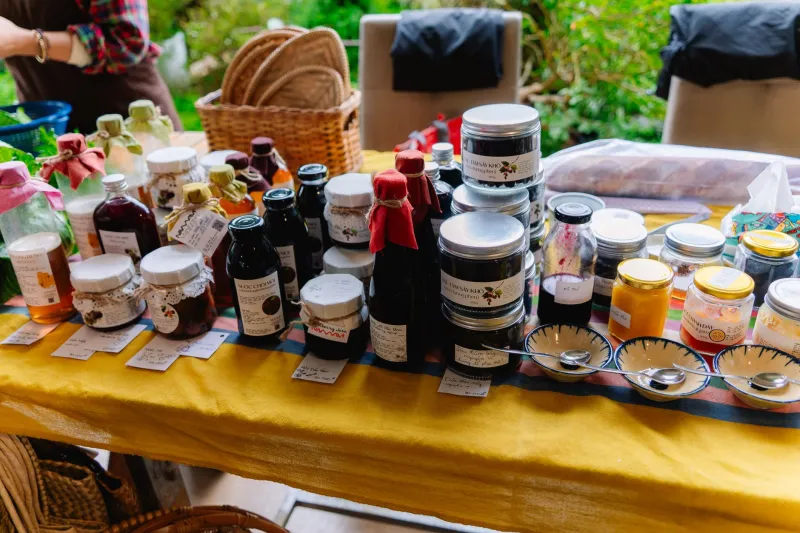
The offer came in on a Tuesday. A national distributor, one of the big ones, wanted to put Maribel Contreras's hot sauce in 4,000 grocery stores across the southeastern United States. There would be a reformulation required — a small one, they said, just to extend shelf life and reduce cost — and a packaging redesign to make the product "more accessible to a general audience."
Contreras, who makes her Guatemalan-inspired salsa negra in a licensed commercial kitchen in Allapattah using charred chilhuacle negro peppers and a family recipe her aunt brought from Quetzaltenango, read the email twice. Then she closed her laptop and went back to work.
"They wanted to change the chilies," she says simply. "I don't change the chilies."
She turned the deal down. The distributor followed up twice. She turned it down twice more. Her salsa negra is still made in small batches, still sold at three Miami farmers markets and a handful of local specialty shops, and still made with the exact chilies her aunt specified. She is not wealthy. She is not famous. She sleeps fine.
The Calculus of Compromise
Miami's independent food scene is full of stories like Contreras's — entrepreneurs who have reached a fork between growth and integrity and chosen, deliberately, the harder road. What makes these stories interesting isn't the refusal itself. It's the reasoning behind it, which tends to be more sophisticated and more emotionally complex than a simple preference for staying small.
For many of the city's Latin and Mediterranean food creators, their product isn't just a product. It's a cultural artifact, a family document, a form of testimony. The recipe is the point. The sourcing is the point. The specific way a thing tastes — because of where it came from and how it was made — is the entire value proposition. Compromise that, and you don't have a scaled-up version of the thing. You have a different thing wearing the same name.
"I've watched other people take those deals," says Esteban Ruiz, who runs a small-batch Colombian aguardiente-inspired aperitif operation out of a licensed facility in Doral. "A year later, the product is different. Two years later, the community that loved it has moved on. The deal made them money and cost them everything that made them special. That's not a deal I want."
Ruiz was approached by two spirits industry investors in the past 18 months. Both conversations ended the same way — with the investors asking for production volume changes that would require switching grain sources and adjusting the botanical profile. Ruiz said no both times.
What Gets Lost in Translation
The practical consequences of scaling up often hit hardest in the area of sourcing. Miami's most integrity-driven food producers tend to be deeply specific about where their ingredients come from — and that specificity is almost always the first casualty of growth.
Chef and restaurateur Fatima Al-Rashid, who runs a Lebanese-Venezuelan kitchen in the Roads neighborhood, spent three years building relationships with a small network of South Florida farmers who grow the herbs and vegetables she needs. Purslane, fenugreek, bitter melon, ají dulce — the kind of specialty produce that doesn't show up in a Sysco catalog. When a hospitality group approached her about opening two additional locations, the conversation quickly ran into a wall.
"They wanted me to show them how I'd source at scale," she says. "And the honest answer was: I can't. The farm that grows my purslane has half an acre. There's no scale version of that relationship. If I open three restaurants, two of them are lying."
She passed on the expansion. The Roads location remains the only one. On a busy Saturday night, it has a two-hour wait.
The Community Cost of Selling Out
There's a social dimension to these decisions that doesn't always make it into business school case studies. In Miami's tightly connected immigrant food communities, reputation is currency — and the currency depreciates fast when a beloved creator is perceived to have traded authenticity for reach.
Contreras describes watching a neighborhood tamale maker she grew up admiring sign a deal with a regional supermarket chain a few years back. The product changed. The price went up. The people who had supported the business from the beginning felt, in Contreras's word, "abandoned."
"She didn't just lose customers," Contreras says. "She lost her community. People who had been coming to her for 15 years stopped coming. That's not recoverable."
This isn't to romanticize financial struggle or suggest that staying small is inherently virtuous. Several of the entrepreneurs interviewed for this piece are candid about the real costs of their choices — the years of thin margins, the personal financial stress, the exhaustion of doing everything yourself because you can't afford to hire enough people. Principled business decisions don't pay rent.
"I don't want anyone to think this is easy," says Ruiz. "I've had months where I wasn't sure I could keep the lights on. I've had conversations with my wife about whether any of this makes sense. I'm not romanticizing it. I'm just saying the alternative — making something I don't believe in — that's not survivable for me either. It's a different kind of cost."
Finding the Third Option
The most interesting development in this space is the growing number of Miami food entrepreneurs who are finding ways to grow without compromising — not by refusing all expansion, but by expanding on their own terms.
Contreras, despite her distributor refusals, has quietly tripled her production over the past two years by adding a fourth farmers market and launching a direct-to-consumer shipping operation. She still controls every batch. She still uses the same chilies. She's making more money than she was three years ago and hasn't changed a single ingredient.
Al-Rashid is exploring a licensing model that would allow a second location to operate under her name only if it can demonstrate access to equivalent sourcing — a high bar that has so far eliminated every prospective partner who's approached her. She's fine with that.
"The right partner will understand why the purslane matters," she says. "If they don't understand that, they're not the right partner."
Esteban Ruiz recently signed a distribution agreement with a small regional spirits importer who specializes in artisan Latin American products and explicitly does not require reformulation. The deal is smaller than what the investors offered. The margins are thinner. He describes it as the best business decision he's ever made.
What They're Actually Protecting
Ask any of these entrepreneurs what they're really protecting when they turn down a deal, and the answers converge on something that doesn't fit neatly into a business framework.
They're protecting the right to say that what they make is actually what they say it is. That the story on the label is true. That the person eating their food is getting the real thing — the thing that connects to a place, a family, a memory that belongs to a community and not a corporation.
In a food culture increasingly saturated with authentic-seeming products that are nothing of the sort, that protection has real value. It's just not always the kind that shows up in a term sheet.
Maribel Contreras is at the farmers market again this Saturday. The chilies are the same ones. The line starts early.