Salt, Sofrito, and Something Heavier: How Miami Families Are Healing Around the Table
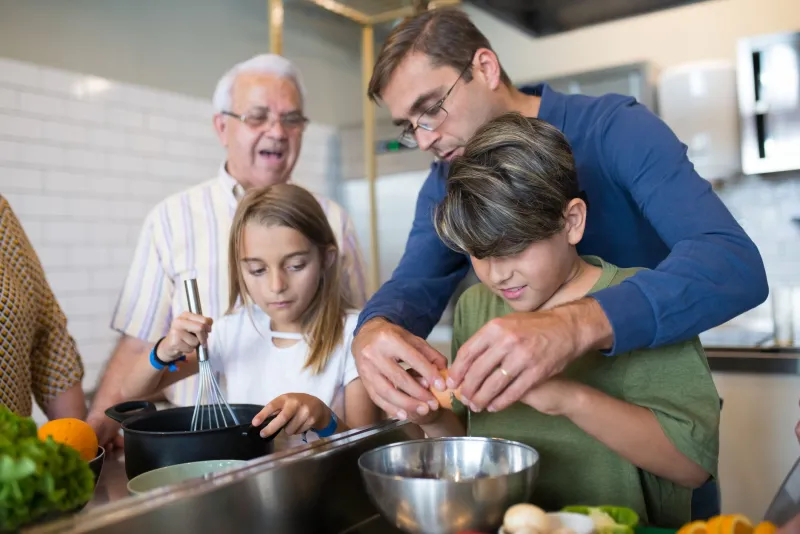
The recipe doesn't exist on paper. It never did. It lives in the hands of a 74-year-old woman in Hialeah who learned it from her mother in Havana, who learned it from her mother before that, in a kitchen that no longer exists in a neighborhood that looks nothing like it did. Every Sunday, her daughter and two grandchildren come over. They don't always talk much. But they cook. And something in that cooking does a thing that nothing else quite manages to do.
"It's the only time I don't feel like I'm missing something," her daughter says. She's quiet for a moment. "I don't know how else to explain it."
She doesn't have to. Anyone who grew up in a Miami immigrant household — Cuban, Colombian, Greek, Lebanese, Venezuelan, Peruvian — probably understands exactly what she means.
When the Kitchen Becomes the Couch
Food and emotional wellbeing have always been tangled together, but the conversation around that connection has gotten more explicit in recent years. Therapists working with immigrant and first-generation communities are increasingly recognizing what those communities have always known: that cooking and communal eating function as genuine psychological tools. Not metaphorically. Practically.
"There's a concept in trauma therapy about somatic memory — the way the body holds onto experiences that the mind can't fully articulate," explains a Miami-based therapist who works primarily with Latin American immigrant families. "Cooking activates that. The smell of a particular spice, the texture of a dough you've worked with your hands — these things access emotional material that talking doesn't always reach."
For families navigating displacement, this matters enormously. The loss of a home country isn't just geographic. It's sensory. It's the specific weight of the air in a particular kitchen, the sound of a market, the taste of something you can't fully recreate but keep trying to. Cooking becomes a form of translation — an attempt to carry something across a border that can't be crossed any other way.
Three Generations, One Kitchen, No Recipe
In a Doral home on a Saturday morning, three generations of a Venezuelan family are making hallacas. The grandmother, who arrived in Miami eleven years ago, is in charge. Her daughter — who was seventeen when they left Caracas — is at the stove. Her granddaughter, who was born in Florida and speaks Spanish with an accent her grandmother gently corrects, is learning to fold the banana leaves.
They argue about the filling. They always argue about the filling. The grandmother insists on a particular ratio of olives to raisins that her daughter thinks is wrong. This argument has been happening for eleven years. Neither of them is going to win it.
"It's the best argument," the daughter says, laughing. "Because it means we're still doing it."
The hallacas will take most of the day. That's the point. The length of the process is not incidental — it's the whole mechanism. The hours of labor create a space where conversation happens without being forced, where memories surface naturally, where the granddaughter learns something about where she comes from in a way that no family meeting or formal lesson could replicate.
"I can't take her to Venezuela right now," the grandmother says quietly. "But I can show her this. This is Venezuela."
Grief Has a Flavor
Not every story around Miami's immigrant dinner tables is warm. Some of the food being cooked carries grief so specific it has a shape. The dish someone's father made every year for a holiday that no longer gets celebrated the same way. The ingredient that only tastes right in a certain season, in a certain place, with certain people who are no longer here. The recipe that died with someone and had to be reconstructed from incomplete memory.
A Lebanese-American woman in South Beach describes making her late mother's kibbeh for the first time alone. Her mother had come to Miami in the 1980s, built a life, and passed away two years ago. "I didn't realize how much of how she made it I had absorbed just from being in the room," she says. "My hands knew things I didn't know they knew."
She cried through the whole process. She made it again the following week. And the week after that.
"It felt like talking to her. It still does."
This is what food therapists sometimes call "continuing bonds" — the way rituals of remembrance allow grief to coexist with ongoing life rather than requiring a clean break. Cooking a dead parent's recipe is not denial. It's a form of relationship maintenance. It's a way of saying: you're still here in the ways I can hold onto.
The Table as Resistance
There's a political dimension to this too, even when no one at the table is thinking about politics. For Miami's immigrant communities — many of whom left countries under authoritarian regimes, economic collapse, or social instability — maintaining food traditions is an act of cultural resistance. It's a refusal to let displacement erase identity.
A Colombian family in Kendall that fled Bogotá eight years ago holds a monthly Sunday dinner they call simply "la reunión." Extended family, friends, neighbors — anyone who wants to come. The table is always too small. There's always too much food. "We're not going to let what happened to us make us smaller," the matriarch explains. "The table is how we say: we're still here. We're still us."
This isn't therapy in the clinical sense. But it functions the way therapy is supposed to — it creates space for processing, for connection, for the kind of meaning-making that helps people survive hard things.
What Miami Knows That the Rest of the Country Is Still Learning
Miami has always been a city of arrivals. People come here carrying everything they could fit in a bag and the memory of everything they couldn't. The food they cook in their new kitchens is the most portable thing they brought — not a physical object but a practice, a knowledge, a set of gestures that belong to a place even when the person performing them is somewhere else entirely.
What Miami's immigrant families have understood for generations is that the dinner table is not just where you eat. It's where you figure out who you still are, who you're becoming, and who you want the next generation to be. It's where the distance between here and home gets negotiated, one meal at a time.
That's not a small thing. That might be everything.
The hallacas, by the way, come out perfectly. The grandmother doesn't say so out loud. But she eats two, which is how everyone at the table knows.